Table of Contents
It usually starts small. An eye roll when you ask them to clean their room. A heavy sigh when you call them for dinner. A mumbled “Ugh, fine” when you remind them about homework.
In the modern world, this behavior is often dismissed as “normal.” We see it in cartoons, in movies, and on social media: the clueless or annoying mom and the sassy, “independent” child. Disrespect has been normalized as a rite of passage. We are told, “They’re just expressing themselves.”
But in a Muslim home, the standard is different.
In Islam, the status of a mother is so high that Paradise – the ultimate goal of every believer is placed at her feet. Raising children with Adab for Mothers (manners/respect towards mothers) isn’t just about having a quiet house or obedient kids. It is a matter of their salvation. It is about teaching them that their relationship with Allah is directly tied to their relationship with you.
However, we cannot demand respect simply by shouting, “I am your mother!” True Adab for Mothers is cultivated. It is taught through stories, modeled through behavior, and nurtured with love.
Here is a guide to reviving the prophetic tradition of honoring mothers in a world that often forgets.
The Status: Why “Adab for Mothers” Matters
To teach a child respect, we first have to teach them value. A child treats a diamond differently than they treat a rock because they understand the value of the diamond.
Do our children understand the spiritual value of their mother?
We all know the famous Hadith, but does it live in our homes? Abu Huraira reported: A man asked the Messenger of Allah, peace and blessings be upon him, “Who is most deserving of my good company?” The Prophet said, “Your mother.” The man asked, “Then who?” The Prophet said “Your mother.” The man asked again, “Then who?” The Prophet said, “Your mother.” The man asked again, “Then who?” The Prophet said, “Your father.” (Ṣaḥīḥ al-Bukhārī 5971).
The Lesson: This isn’t just a nice quote. It is a hierarchy of Adab for mothers. It means she gets 75% of the love, the patience, and the soft speech. Teach your child: “Allah put Mommy three levels above everyone else. Treating her well is the fastest way to make Allah happy.”
1. The Adab of Speech: Banning the “Uff”
The Qur’an sets a terrifyingly high standard for how we speak to parents.
“…say not to them [so much as], ‘Uff,’ and do not repel them but speak to them a noble word.” (Surah Al-Isra, 17:23).
“Uff” is the smallest expression of annoyance. It is a huff. A sigh. An eye-roll. If even a sigh is forbidden, what about yelling? What about sarcasm? What about ignoring her?
Practical Training: The “Rewind” Rule We need to train our children to catch their tone. If a child responds with attitude (e.g., “WHY do I have to do it now??”), pause immediately. Do not engage with the content of what they said. Engage with the tone.
Say gently: “That sounded like ‘Uff.’ In this house, we speak to Mommy with a noble voice. Let’s hit the rewind button. Try asking me that again with a soft voice.”
This separates the child from the behavior. It allows them to practice the correct Adab for mothers without being shamed. It teaches emotional regulation.
For more on Qur’anic commands regarding parents, read our deep dive: Respecting Parents in Islam.
2. The Adab of Service (Khidmah)
In the West, we often raise children to be “independent.” We want them to do everything for themselves. While self-sufficiency is good, Islam balances it with Khidmah, service to others, especially parents.
We want to raise children who don’t just clean their own plates but who rush to get Mommy’s water.
The Example of Ibn Umar: Abdullah ibn Umar (RA) saw a Yemeni man circling the Kaaba while carrying his mother on his back. The man asked, “O Ibn Umar, have I repaid her?” Ibn Umar replied, “No, not even for one contraction did she feel giving birth to you.”
Practical Training: Create opportunities for service to instill Adab for Mothers.
The Water Rule: Teach them that if Mommy asks for water, they don’t just point to the fridge. They get up, pour it, and bring it to her.
The Door Rule: If walking with Mommy, the child holds the door open.
Small acts of service break the ego. They remind the child that they are not the center of the universe—their duty to their parents is.
3. The Adab of Physical Affection
Respect isn’t just about what we don’t do (don’t yell); it’s about what we do do. The Prophet ﷺ taught us the power of physical touch in showing respect.
The Example of Fatima (RA): When the Prophet ﷺ would enter the room, his daughter Fatima (RA) would stand up, take his hand, kiss it, and make him sit in her place. And when she entered, he would do the same for her.
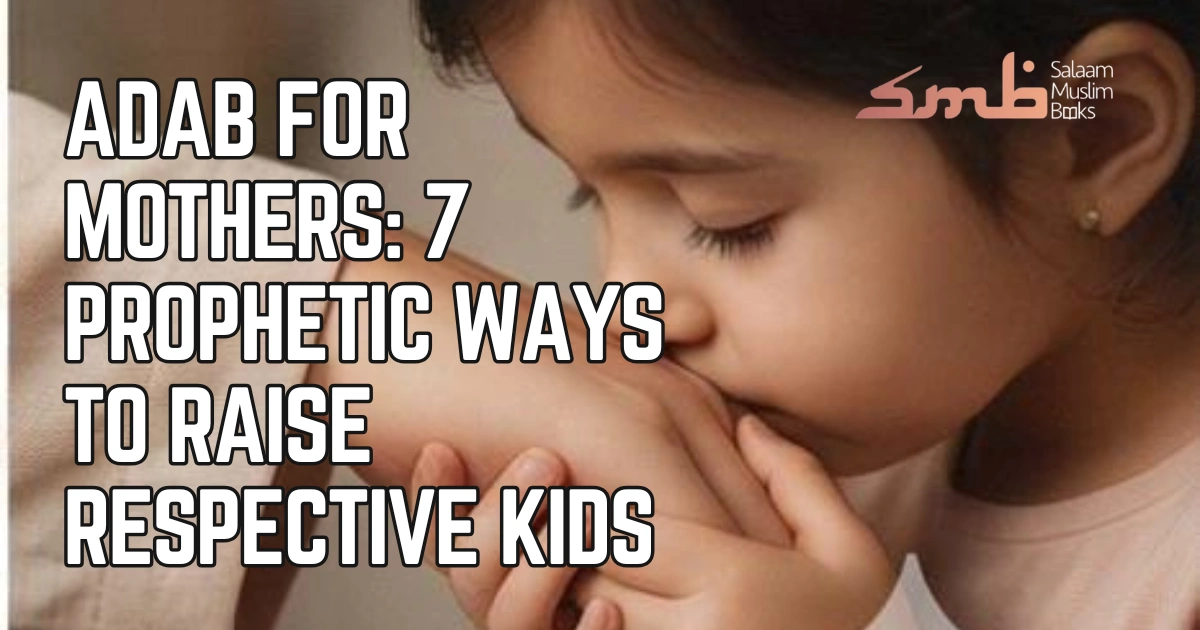
Practical Training: Revive the lost Sunnah of kissing the parents’ hands or forehead.
- Teach your children to kiss your hand or head when they leave the house or when they return from school.
- This might feel awkward at first in a Western context, but it breeds a deep psychological reverence. It is a physical manifestation of Adab for Mothers.
4. The Role of the Father: Setting the Standard
This point is for the fathers. You cannot raise children with Adab for Mothers if the father treats the mother with disrespect. Children are mirrors.
- If the father speaks to his wife with sarcasm, the son will speak to his mother with sarcasm.
- If the father ignores her requests, the daughter will ignore her requests.
- If the father serves her, honors her, and speaks gently to her, the children will follow.
The Strategy: Fathers must be the enforcers of this Adab. If a child speaks rudely to their mother, the father should intervene, not with anger, but with firmness. “That is your mother. That is the queen of this house. We do not speak to her like that.”
5. Storytelling: Teaching Without Preaching
As we have discussed in our previous blogs, stories are the most powerful way to shape behavior. If you constantly lecture your child about respect, they may tune you out. But if you read them a story about a child who loves his mom, they will want to emulate that character.
Recommendation: Being Kind to Mommy This book is an essential tool for your library to teach Adab for Mothers.
It follows a young boy named Ali who learns that kindness to his mother is his gateway to Jannah.
It visualizes the abstract concept of Adab. It shows the child how to be kind – sharing toys, speaking softly, and helping out.
It connects the mother directly to Paradise. For a child who wants to go to Jannah (who wants the ultimate reward), this link is powerful motivation.
For more general tips on nurturing softness, read Teaching Kindness to Children.
6. The “Look” of Love (Active Listening)
In the age of smartphones, Adab for Mothers faces a new enemy: the screen. How often do we speak to our children while they are looking at a tablet? Or vice versa?
The Prophet ﷺ gave his full attention when spoken to. He turned his whole body. Teach your child the “Eyes on Mom” rule.
“When Mommy speaks, the screen goes down and the eyes go up.”
This is basic human decency, but it is also a spiritual act. It tells the mother, “You are important to me.”
7. Connecting It to Allah
Finally, the most critical part of teaching Adab for Mothers is reminding them that this is a command from Allah.
If they respect you just because you are “Mom,” that might fade when they become teenagers and think they know better than you. But if they respect you because Allah commanded it, that never fades.
“I know you are frustrated with my rules. You don’t have to agree with me. But Allah asked you to be kind to me. Do it for Allah, even if you don’t want to do it for me.”
This shifts the dynamic. It stops being a power struggle between parent and child and becomes an act of worship.
Addressing the “Imperfect Mom” Guilt
Mothers often feel guilty demanding respect because they know they aren’t perfect. You might lose your temper. You might make mistakes. You might think, “I don’t deserve this high status.”
But Allah’s command to respect parents is unconditional. It does not say, “Respect your parents ONLY if they are calm and perfect.” Even when parents were polytheists calling to Shirk, the Quran commands the child to treat them with “good company” in this world.
So, do not feel shy about enforcing Adab for mothers. You are not doing it for your ego. You are doing it to save your child’s soul. You are teaching them gratitude. You are opening the doors of Jannah for them.
The Gateway to Jannah
There is a beautiful narration where a man came to the Prophet ﷺ wanting to join a military expedition (Jihad). The Prophet ﷺ asked if his mother was alive. The man said yes. The Prophet ﷺ said:
“Then stay with her and attend to her, for Paradise is at her feet.” (Sunan An-Nasa’i 3104).
This is the message we want to sink into our children’s hearts. Serving Mom isn’t a chore. It isn’t a burden. It is the VIP ticket to the greatest reward Allah has created.
By raising children with Adab for Mothers, we are raising a generation that is softer, kinder, and more connected to the mercy of Allah.
Resources to Cultivate Adab:
Being Kind to Mommy: The perfect bedtime read to reinforce these lessons.
Which of these Adab tips do you find hardest to implement? Let’s discuss in the comments!