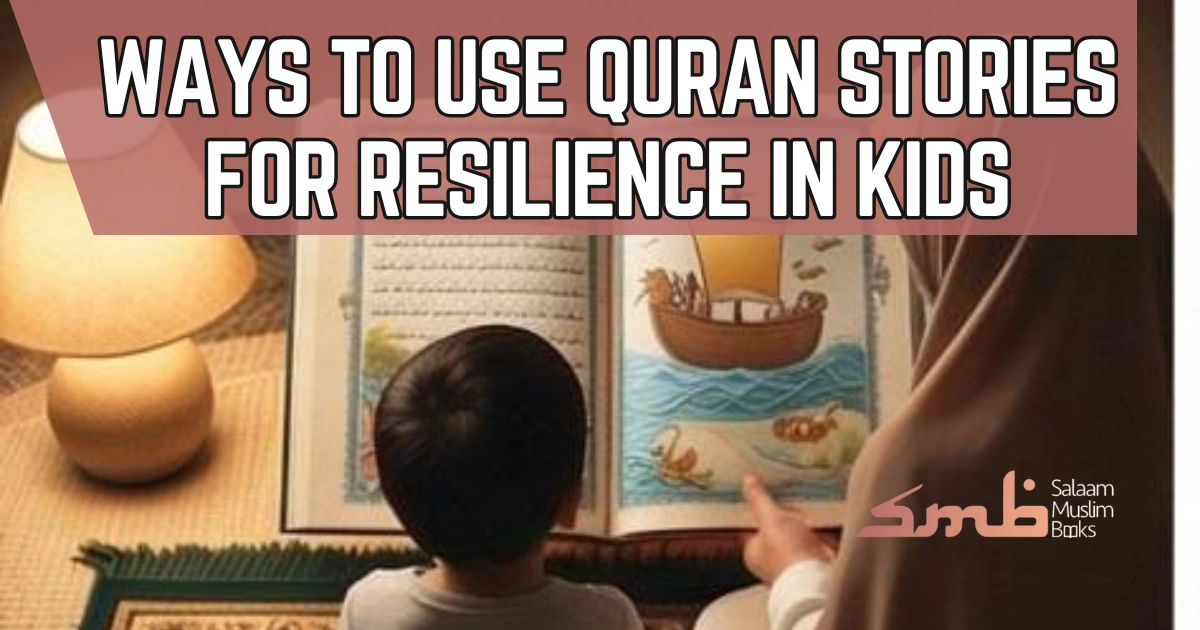
We often look for resilience in concepts like “tough love” or strict discipline. We worry that if we are too soft, our children won’t be ready for the harsh realities of the world. But in Islam, the strongest hearts are not built through hardening; they are built through stories.
Using Quran stories for resilience is one of the most gentle, effective ways to prepare our children for the world. It provides them with an emotional anchor that holds firm even when the waves of life get high.
As parents, we often struggle to explain big, abstract concepts like patience (Sabr) or trust (Tawakkul) to a toddler who is crying over a broken toy, or a seven-year-old anxious about a math test. Logic rarely works in these moments. This is where the Qur’an becomes a parenting miracle. It isn’t just a book of rules; it is a library of human emotion.
Here is how you can transform bedtime storytelling into a workshop for emotional intelligence, using the timeless examples of the Prophets.
Table of Contents
Why Storytelling Builds Stronger Hearts than Lectures
Science and Sunnah agree: the human brain is wired for narrative. When you lecture a child saying, “You need to be patient because Allah loves the patient,” their logical brain often shuts down, especially if they are already upset.
But when you tell a story, their emotional brain lights up.
Using Quran stories for resilience allows a child to “practice” emotions in a safe space. They feel the fear of the raging sea with Prophet Musa (AS) and the crushing sadness of the dark well with Prophet Yusuf (AS), all while safe in your lap. This “emotional rehearsal” is what builds true grit. When they eventually face their own “wells” or “seas” in life, their brain recognizes the pattern and knows there is a way out.
“We relate to you, [O Muhammad], the best of stories in what We have revealed to you of this Qur’an…” (Surah Yusuf, 12:3)
If you are new to the art of narrative, you can learn more about the basics in our guide on Why Storytelling Matters in Muslim Households (and How to Start).
Here are 5 powerful ways to use these stories to teach resilience effectively.
1. Teach Persistence Through Prophet Nuh (AS)
The first way to use Quran stories for resilience is to address the fear of failure, peer pressure, and mockery.
The Challenge
Prophet Nuh (AS) built a ship in the middle of a dry desert, far from any water, while his people laughed at him. This ridicule did not last days or years, but centuries.
The Lesson for Children
Doing the right thing can feel lonely. Resilience means continuing to build our “ship,” our good deeds and goals, even when others do not understand.
How to Tell the Story
Focus on the feelings, not just the outcome.
Ask your child how it would feel if they were building something they loved and everyone laughed at them.
You might say:
“Nuh (AS) heard them laughing, and it probably hurt his feelings. But he did not stop. He cared more about what Allah thought than what people thought, and that made him strong.”
This is a vital lesson for school-aged children navigating friendships. For more on helping children manage social influences, read Protecting Their Faith Without Isolating Them.
2. Find Hope in the Dark with Prophet Yusuf (AS)
Resilience isn’t just about toughness; it’s about maintaining hope when the lights go out.
The Challenge
Prophet Yusuf (AS) was thrown into a dark, deep well by his own brothers and left completely alone.
The Lesson for Children
Being alone does not mean being abandoned. Allah is present even in the darkest moments.
How to Tell the Story
Use gentle sensory details.
“It was dark and cold. There were no toys, no lights, and no family nearby. Yusuf (AS) was all by himself.”
Then bring comfort into the story.
“But Allah was there, watching over him. Because Yusuf trusted Allah, that dark well became the first step toward something greater.”
This story is especially comforting for children who fear the dark or struggle with separation anxiety.
3. Conquer Anxiety with Prophet Musa (AS)
Anxiety is increasingly common in children today. The story of the Red Sea is the ultimate antidote to the feeling of being “stuck.”
The Challenge
Prophet Musa (AS) stood before a vast sea, with an angry army behind him. From a human perspective, there was no escape.
The Lesson for Children
When there seems to be no way forward, Allah can create a path.
How to Tell the Story
“Musa (AS) did not know the sea would split. He did not have a plan. He simply trusted that Allah was with him.”
Teach your child a short phrase they can use when they feel anxious:
“Allah is with me.”
To help them practicalize this, teach them simple supplications. You can find a step-by-step approach in How to Make Du’a: A Simple Guide for Little Hearts.
4. Simplify the “Vocabulary of Faith” for Toddlers (Ages 0-5)
Big stories can be overwhelming for little ears. To effectively use Quran stories for resilience with toddlers, we must first simplify the vocabulary of faith.
Before a child can understand the complex patience of Nuh (AS), they need to understand the basic concept of Bismillah (starting with Allah) and Alhamdulillah (trusting Allah in all situations).
If we try to tell complex narratives too early, we might lose their interest. Instead, we should focus on the feelings of the story.
This is exactly why we created My First Book About Islam. It doesn’t overwhelm toddlers with dates and maps; it introduces the feelings of faith through simple words and pictures. It acts as the perfect “pre-school” for Quranic storytelling.
For this age group, you can also use books like Learning About Allah and Islam with Tabeed the Tractor, which makes the concepts of faith fun and engaging.
- Further Reading: Teaching Tawheed to Toddlers: 5 Simple and Powerful Everyday Tips.
5. Change How You Tell the Story (The “Feeling” Technique)
To truly build resilience, you must move from “reading” to “engaging.” Don’t just lecture; activate their emotional intelligence.
Ask Feeling Questions
Instead of asking what happened next, ask how the Prophet might have felt.
“How do you think Yusuf felt in the well?”
“Do you think Nuh felt sad when people laughed at him?”
Connect the Story to Their Life
“Remember when you were sad because you lost your favorite toy? That feeling is a little like how Yaqub (AS) felt. What did he do when he was sad?”
Create a Calm Environment
A cozy, quiet space helps children associate the Qur’an with comfort and safety.s. To make these stories stick, create a cozy, safe environment where your child associates the Qur’an with comfort.
Read our guide on How to Create a Reading Corner in Your Home to set up a special space for these conversations.
Practical Bedtime Tips for “Emotional” Storytelling
Integrating Quran stories for resilience into your nightly routine doesn’t have to be complicated.
A Simple Bedtime Routine for Emotional Storytelling
- Put devices away and give your child your full attention.
- Read a short story or a single page together.
- End with a specific du’a related to the story. For example, “O Allah, make us brave like Musa and patient like Yusuf.”
If you are looking for more book recommendations to add to your library, Hiba’s Egg Allergy is a wonderful modern story that teaches resilience in the face of health challenges and acknowledging Al-Qadr (Divine Decree).
Final Thought: Building Resilience One Story at a Time
Resilience isn’t built in a day. It isn’t built by a single lecture or one strict punishment. It is built one story, one whisper, and one bedtime routine at a time.
When we use Quran stories for resilience, we are giving our children the ultimate toolkit for life. We are teaching them that difficulty is not a sign that Allah has left them, but a sign that their story is still being written.
- When they face a bully, they will remember Nuh (AS).
- When they feel lonely, they will remember Yusuf (AS).
- When they are anxious, they will remember Musa (AS).
As parents, we don’t need to be scholars to share these lessons. We just need to be sincere. We need to focus on the feelings within the story and connect them to the little hearts beating in front of us.
If you are looking for a gentle way to start these conversations, our books are designed to be your partner. They bridge the gap between big Islamic concepts and little Muslim hearts, ensuring that your child’s introduction to their faith is paved with love, familiarity, and understanding.
Don’t just read about it. Help your child live it.
Start their journey with a foundation of love today.